
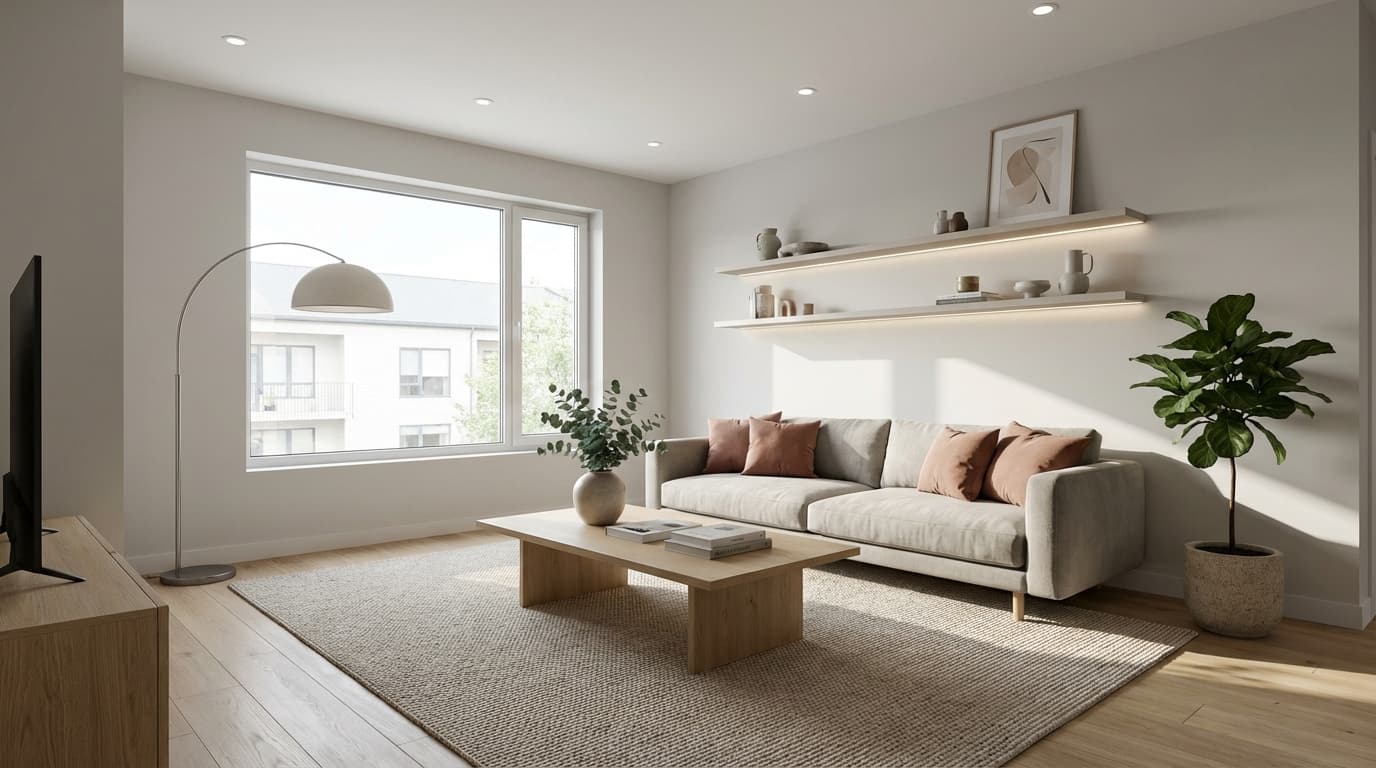
So nutzen Sie diese 2026 Home Staging Checkliste (Makler, private Verkäufer und Bauträger)
Schneller verkaufen mit besseren Immobilienfotos
Virtual Staging hilft Käufern, den Raum zu visualisieren. Testen Sie HomestagingKI kostenlos: 2 Bilder inklusive.
- Schritt 1 (30 Minuten): Begehung mit dem Smartphone und Notieren von „Fotoproblemen“ (Blendung, Unordnung, Maßstab, tote Ecken).
- Schritt 2 (60 Minuten): Beheben Sie die Top 3 Fotoprobleme im ersten Bildsatz (meist Eingang + Wohnzimmer + Küche).
- Schritt 3 (am selben Tag): Entscheiden Sie sich pro Raum für physisches oder virtuelles Staging, basierend auf ROI und Logistik.
- Schritt 4 (24–48 Stunden): Neuaufnahmen machen oder Virtual Staging beauftragen, dann Listing-Medien und Anzeigenmaterial aktualisieren.
- Schritt 5 (wöchentlich): Verfolgen Sie CTR, Besichtigungs-zu-Angebot-Verhältnis und die Veränderung der Vermarktungsdauer nach den Optimierungen.
2026 ROI-Benchmarks: Was Sie vom Staging erwarten können (physisch + virtuell)
Raum-für-Raum Staging-Checkliste für 2026 Immobilien-Listings (mit Quick Wins + ROI-Benchmarks)
HomestagingKI kostenlos testen
Laden Sie ein Raumfoto hoch und erhalten Sie in Minuten eine gestagte Version. Keine Möbellogistik, keine Wartezeiten.
1) Außenbereich + Attraktivität (erstes Foto = erster Filter)
- Quick Wins (0–150 €): Gehwege/Stufen hochdruckreinigen; Fußmatte ersetzen; abgestorbene Pflanzen entfernen; zwei symmetrische Pflanzgefäße hinzufügen; Fenster putzen; Mülltonnen verstecken.
- Budgetfreundliche Upgrades (150–800 €): Haustür streichen/auffrischen; Hausnummern aktualisieren; warme Außenbeleuchtung; Briefkasten reparieren; einfache Mulchbeete anlegen.
- Fotofokus-Details: Autos wegparken; Jalousien öffnen; bei goldener Stunde fotografieren; sicherstellen, dass Verandalampen die Farbtemperatur anpassen.
- Virtual Staging Option: virtuelle Dämmerung, Rasenpflege und Aufräumen des Außenbereichs für konsistente Hero-Bilder.
2) Eingangsbereich + Flur (Hochfrequenz- und Beurteilungszone)
Vorher & Nachher, das Klicks generiert
Fotorealistisches Virtual Staging für Makler und private Verkäufer – optimiert für Portale und Social Ads.
- Quick Wins (kostenlos): Schuhe/Mäntel entfernen; Konsolenflächen freiräumen; Teppiche ausrichten; einen geraden Weg zum Wohnbereich schaffen.
- Beleuchtungs-Quick Win (20–120 €): Auf warme, hoch-CRI-Glühbirnen umrüsten; eine schlanke Lampe hinzufügen; konsistente Farbtemperatur gewährleisten.
- Stil-Akzente (50–250 €): ein Spiegel zur Raumvergrößerung; ein Kunstwerk; eine Schale/Ablage für Schlüssel (für Fotos entfernen).
- Smart-Home Staging (optional): Bewegungsmelder-Beleuchtung oder Smart Lock präsentieren (einfache Beschriftungskarte).
3) Wohnzimmer / Familienzimmer (Lead-Qualität und Angebotsstärke)
- Quick Wins (kostenlos): überflüssige Stühle entfernen; Möbel anordnen, um eine Gesprächszone zu schaffen; Kabel verstecken; Couchtisch freiräumen; überdimensionierte persönliche Fotos entfernen.
- Budget-Upgrades (100–600 €): einen größeren Teppich zur Zonendefinition hinzufügen; auf neutrale Kissen/Decken umstellen; eine große Pflanze hinzufügen; Vorhänge durch lichtfilternde Paneele ersetzen.
- Technik-orientiertes 2026 Add-on (50–250 €): smarter Dimmer + voreingestellte „Besichtigungsmodus“-Beleuchtung; dezent für Besichtigungen kennzeichnen.
- Virtual Staging Option: unpassende Möbel ersetzen, moderne neutrale Elemente hinzufügen und den Maßstab für Weitwinkelaufnahmen korrigieren.
4) Küche (CTR-Motor + „veraltet“-Einwand-Killer)
Benötigen Sie bessere Fotos für Ihr Inserat?
Verwandeln Sie leere Räume in warme, moderne Interieurs. Erhöhen Sie das Engagement und verkürzen Sie die Vermarktungsdauer.
- Quick Wins (0–80 €): Arbeitsflächen freiräumen (maximal 1–2 Gegenstände belassen); Kühlschrankmagnete entfernen; Barhocker ausrichten; durchgebrannte Glühbirnen ersetzen; Spüle und Armatur gründlich reinigen.
- Upgrade unter 500 €, das wie eine Renovierung aussieht: Wände/Schränke (wo angebracht) in einem neutralen Farbton streichen; Griffe/Knöpfe aktualisieren; einen einfachen selbstklebenden Fliesenspiegel nur anbringen, wenn er realistisch und sauber aussieht.
- Gerätestrategie: Wenn die Geräte nicht zusammenpassen, priorisieren Sie visuelle Konsistenz (Edelstahl-Optik, passende Griffe) gegenüber „High-End“.
- Staging-Requisiten: ein Schneidebrett + eine Schale mit grünen Äpfeln/Zitronen; eine kleine Pflanze; keine Unordnung.
- Virtual Staging Option: Oberflächen modernisieren, Pendelleuchten hinzufügen und Farbstich korrigieren; glaubwürdig und passend zur Preisklasse der Immobilie halten.
5) Essbereich (lassen Sie ihn größer wirken, als er ist)
In vielen Häusern werden Essbereiche oft zu Abstellflächen. Auf Fotos wirkt dies schnell als „kein Platz“. Ihr Ziel für 2026 ist es, die Sitzkapazität und die Zirkulation klar darzustellen, um den Raum als funktionalen Treffpunkt für Familie und Freunde zu präsentieren. Ein gut inszenierter Essbereich kann den wahrgenommenen Wert der Immobilie erheblich steigern und Käufern helfen, sich das Leben dort vorzustellen.
- Quick Wins: überflüssige Stühle entfernen; Tisch zentrieren; einen einfachen Läufer hinzufügen; Tischdekoration niedrig halten.
- Beleuchtung: sicherstellen, dass Pendel-/Kronleuchter sauber und warmtonig ist; grelle Glühbirnen ersetzen.
- Virtual Staging: ein passend skaliertes Tischset hinzufügen, wenn der Raum leer oder ungünstig möbliert ist.
6) Hauptschlafzimmer (Ruhe verkauft – und erhöht die CTR)
- Quick Wins (kostenlos): überschüssige Möbel entfernen; Nachttische freiräumen; Wäschekörbe verstecken; saisonale Kleidung verstauen; das Bett straff und symmetrisch machen.
- Budget-Upgrades (80–300 €): neuer neutraler Bettbezug; zwei passende Kissen; Nachttischlampen; Verdunkelungs- oder lichtfilternde Vorhänge je nach Lichteinfall.
- Schrank-Staging: Kleidungsvolumen um 30–50% reduzieren; passende Kleiderbügel; eine Aufbewahrungsbox für visuelle Ordnung.
- Virtual Staging: ein modernes Bettgestell, Kunst und ausgewogene Beleuchtung hinzufügen; den Stil an das Käuferprofil anpassen, dabei aber neutral bleiben.
7) Nebenschlafzimmer (Flex-Räume gewinnen 2026)
Nebenschlafzimmer sollten eine Frage beantworten: „Was kann ich mit diesem Raum anfangen?“ Im Jahr 2026 hilft Flex-Staging (Gästezimmer + Büro, Kinderzimmer, Hobbyraum) Käufern, den Preis zu rechtfertigen und reduziert Einwände wie „zu klein“.
- Quick Wins: eine Funktion pro Raum festlegen; überflüssige Gegenstände entfernen; Böden sichtbar lassen.
- Budget-Upgrades: kompakter Schreibtisch + Stuhl für Büro; Tagesbett für Gästezimmer; einfacher Teppich zur Zonendefinition.
- Virtual Staging: ideal für ungünstig geschnittene Räume – zeigen Sie ein realistisches Büro-/Gästezimmer-Setup, ohne Möbel kaufen zu müssen.
8) Badezimmer (kleiner Raum, große Wirkung)
- Quick Wins (0–60 €): alle persönlichen Gegenstände entfernen; neue weiße Handtücher; Duschablagen freiräumen; Toilettendeckel schließen; eine kleine Pflanze oder einen neutralen Seifenspender hinzufügen.
- Upgrades unter 200 € pro Badezimmer: moderne Armatur oder Duschkopf (wenn DIY-sicher); neuer Spiegel oder Leuchte; frische Silikonfugen wo nötig; passende Beschläge.
- Beleuchtung: helles, schmeichelhaftes Licht priorisieren; blaue/kalte Glühbirnen vermeiden, die Fliesen schmutzig aussehen lassen.
- Virtual Staging: aufhellen, entrümpeln und Armaturen modernisieren (konsistent mit dem tatsächlichen Zustand der Immobilie halten).
9) Home Office / Arbeitszimmer (eine 2026-Erwartung, kein Bonus)
Auch wenn Käufer nicht Vollzeit von zu Hause aus arbeiten, erwarten sie eine funktionale Nische. Das Staging eines klaren Arbeitsplatzes verbessert den wahrgenommenen Nutzen und kann die Lead-Qualität erhöhen, indem es sich an die Lebensstilbedürfnisse anpasst.
- Quick Wins: Schreibtisch freiräumen; Kabel verstecken; eine Arbeitslampe hinzufügen; Stuhl ordentlich unter den Tisch schieben.
- Budget-Upgrades: einfache Regalgestaltung; neutrale Pinnwand; eine Pflanze.
- Virtual Staging: eine leere Ecke in ein kompaktes Büro umwandeln, um Raumzahl und Funktion zu rechtfertigen.
10) Waschküche / Hauswirtschaftsraum (Reduzierung von „Wartungsängsten“)
Waschküchen verkaufen zwar nicht den Traum vom Eigenheim, können ihn aber schnell zunichtemachen. Im Jahr 2026 achten Käufer besonders auf Anzeichen von mangelnder Wartung – Rost, Unordnung und schlechte Beleuchtung können sofort einen negativen Eindruck hinterlassen. Ein sauberer, gut organisierter Waschraum signalisiert, dass das gesamte Haus gut gepflegt wurde, was das Vertrauen der Käufer stärkt und potenzielle Einwände reduziert.
- Quick Wins: Waschmittel-Unordnung beseitigen; zwei passende Körbe hinzufügen; Maschinen abwischen; Flusenbereich reinigen.
- Budget-Upgrades: Regale hinzufügen; Beleuchtung verbessern; abgenutzte Wände streichen.
- Virtual Staging: minimal – Fokus auf Aufhellung und Entrümpelung, anstatt unrealistische Oberflächen hinzuzufügen.
11) Garage + Abstellraum (Klarheit auf Bauträger-Niveau)
Für Bauträger und hochwertige Immobilien ist die Organisation der Garage ein klares Markenzeichen für Qualität und Liebe zum Detail. Für private Verkäufer ist es eine wichtige Bestätigung für potenzielle Käufer: „Hier gibt es ausreichend Stauraum.“ Eine aufgeräumte Garage maximiert den wahrgenommenen Wert der Immobilie, da sie das Potenzial für Lagerung und Nutzung des Raumes optimal präsentiert und den Eindruck eines gut geführten Haushalts vermittelt.
- Quick Wins: gefährliche Gegenstände entfernen; fegen; Gegenstände in Zonen gruppieren; Boden sichtbar lassen.
- Budget-Upgrades: Wandhaken; ein Regal; Behälter beschriften.
- Virtual Staging: typischerweise nicht empfohlen, es sei denn, Sie erstellen ein komplettes virtuelles Paket; bleiben Sie ehrlich.
12) Außenbereich (Terrasse/Balkon/Garten = Lifestyle-ROI)
- Quick Wins: fegen; abgestorbene Pflanzen entfernen; zwei Stühle und einen kleinen Tisch hinzufügen; Lichterketten (warm) für Abendfotos anbringen.
- Budget-Upgrades: Outdoor-Teppich; Topfpflanzen; Zaunfarbe auffrischen, wo sichtbar.
- Virtual Staging: Outdoor-Möbelsets und Grünpflanzen hinzufügen; virtuelle Dämmerung für Hero-Aufnahmen in Betracht ziehen.
ROI-Benchmark (Richtwert): Outdoor-Staging wird häufig als Verbesserung des ersten Eindrucks und der Lead-Konversion genannt; 2026-Prognosen nennen oft starke Renditen (üblicherweise um ~18% für gezielte Außen-/Quick Wins).
Virtual Staging für 2026 Immobilien-Listings: Wo es physisches Staging übertrifft (und wo nicht)
Virtual Staging Trends 2026: KI-Realismus, Brand Kits und CTR-Tests
KI in Immobilienvideos integrieren (Virtual Staging und mehr!)
Standardisierte Staging-Prozesse (damit Teams Ergebnisse über mehrere Listings skalieren können)
- Erstellen Sie eine „Top 5 Fotos“-Regel: Eingang, Wohnzimmer, Küche, Hauptschlafzimmer, bestes Badezimmer müssen zuerst inszeniert werden.
- Verwenden Sie eine einzige Einkaufsliste: warme Glühbirnen, weiße Handtücher, neutrale Bettwäsche, zwei Pflanzen, zwei Teppiche, Kabelclips, Mikrofasertuch-Set.
- Legen Sie Fotostandards fest: konsistenter Weißabgleich, gerade Vertikalen, keine persönlichen Fotos, keine Unordnung auf Arbeitsflächen.
- Verfolgen Sie KPIs: Listing-CTR, Anfrage-zu-Besichtigungs-Rate, Besichtigungs-zu-Angebot-Rate, Vermarktungsdauer, Preisreduzierungen.
- Erstellen Sie ein Virtual Staging Style Kit: 3 genehmigte Stile, 1 genehmigte Farbpalette, 1 genehmigtes Kunst-Set.
Häufige Staging-Einwände überwinden (Argumente, die den ROI schützen)
FAQ
„Staging ist teuer – können wir es weglassen?“
„Virtual Staging wirkt irreführend.“
„Wir haben keine Zeit – Fotos sind morgen.“
„Käufer können es sich vorstellen – warum der Aufwand?“
„Welche Räume sind am wichtigsten?“
Zwei Hero-Bild-Ideen, die Sie sofort umsetzen können (mit Vorher/Nachher-Assets)
Schnelle Immobilien-Optimierungen 2026: Die 24-Stunden-Checkliste (wenn Sie schnelle Ergebnisse benötigen)
Wenn ein Listing schnell live gehen soll, konzentrieren Sie sich auf Upgrades, die Fotos sofort verändern und die häufigsten Einwände reduzieren. Dieser Mini-Plan ist für Makler und private Verkäufer konzipiert, die schnelle Erfolge benötigen.
- Stunde 1: Glühbirnen ersetzen/standardisieren (warm, hell), Jalousien öffnen, Glas und Spiegel reinigen.
- Stunde 2: Küchen-Reset – Arbeitsflächen freiräumen, Magnete entfernen, Spüle/Armatur polieren, eine einfache Requisite hinzufügen.
- Stunde 3: Wohnzimmer-Reset – überflüssige Möbel entfernen, Kabel verstecken, Teppich/Kissen hinzufügen, eine klare Sitzzone schaffen.
- Stunde 4: Badezimmer-Reset – alles entfernen, weiße Handtücher hinzufügen, Deckel schließen, Lichter aufhellen.
- Stunde 5: Hauptschlafzimmer – Bett straff machen, Oberflächen freiräumen, Schrankvolumen reduzieren.
- Stunde 6: Außenbereich – fegen, Mülltonnen verstecken, Pflanzgefäße hinzufügen, Fußmatte ausrichten.
- Am selben Tag: Virtual Staging für leere/ungünstig geschnittene Räume bestellen und die ersten 5 Listing-Fotos aktualisieren.
ROI in die Praxis umsetzen: Eine einfache Entscheidungsregel für 2026
Nutzen Sie diese Regel, um zu entscheiden, ob Sie einen Raum inszenieren, aufwerten oder unverändert lassen: Wenn der Raum in den ersten 10 Fotos erscheint oder eine Zone mit hohen Einwänden ist (Küche, Bad), inszenieren Sie ihn. Wenn die Behebung unter den Kosten einer typischen Preissenkung oder einer zusätzlichen Woche Haltekosten liegt, tun Sie es. Wenn die Möbellogistik langsam oder teuer ist, nutzen Sie Virtual Staging.
- Physisches Staging, wenn: Sauberkeit, Geruch, Unordnung, Beleuchtung oder Wartung das Problem sind.
- Virtuelles Staging, wenn: der Raum leer ist, Möbel nicht zusammenpassen oder Sie Marken-Konsistenz über mehrere Listings hinweg benötigen.
- Beides, wenn: das Haus persönlich gut wirken und auch online überzeugen soll (Hybridansatz).
Fazit: Die 2026 Home Staging Checkliste, die Klicks, Besichtigungen und Angebote gewinnt
Staging 2026 ist datengesteuert: Es beeinflusst Klickraten (CTR), Lead-Qualität und Vermarktungsdauer und findet zunehmend digital statt.
Raum-für-Raum-Ansatz mit ROI-Benchmarks: Priorisieren Sie Optimierungen basierend auf deren messbaren Auswirkungen auf den Verkaufserfolg.
Virtual Staging als kosteneffiziente Lösung: Ideal für leere oder ungünstig möblierte Räume, um Kosten zu senken und gleichzeitig die visuelle Attraktivität zu maximieren.
Standardisierte Prozesse und A/B-Tests: Für Makler und Bauträger ist die Skalierung von Staging-Ergebnissen durch konsistente Style Kits und Performance-Tracking entscheidend.
Fokus auf hochwirksame Bereiche: Priorisieren Sie Außenbereich, Eingang, Wohnzimmer, Küche und Hauptschlafzimmer, da diese den ersten Eindruck und die Kaufentscheidung am stärksten beeinflussen.
Sources
- NAR 2023 Profil des Home Staging (study)
- Zillow's Leitfaden zum Home Staging ROI (guide)
- HomeLight's Home Staging Statistiken und Trends (article)
- Redfin's ultimative Home Staging Checkliste (guide)
- Bankrate's Analyse des Home Staging ROI (article)
- Realtor.com Home Staging Statistiken (study)
- Virtual Staging ROI Benchmarks (article)
- Inman's Virtual Staging Trends für 2024 und darüber hinaus (news)
- RESA Home Staging Forschung und Benchmarks (study)
- 2024 Kosten-Nutzen-Bericht zu Haus-Upgrades (study)
- Aufkommende Home Staging Trends für 2025-2026 (article)
- 3D Virtual Staging Plattform (tool)
- Virtual Staging Tools und Dienstleistungen (tool)
- Curbed's Ansicht zu Virtual Staging Trends (news)
- Auswirkungen der Technologie auf Staging (article)
- Apartment Therapy Raum-für-Raum Staging Checkliste (guide)
- Quick Wins für Home Staging (article)
- Häufige Home Staging Einwände überwinden (guide)
- HomeAdvisor Home Staging Kosten und ROI (guide)
- NAR Bericht: Einfluss von Staging auf Hausverkäufe (study)
- KI in Immobilienvideos integrieren (Virtual Staging und mehr!) (youtube)